Lectorea
What to learn, and in what order — university lectures as a map
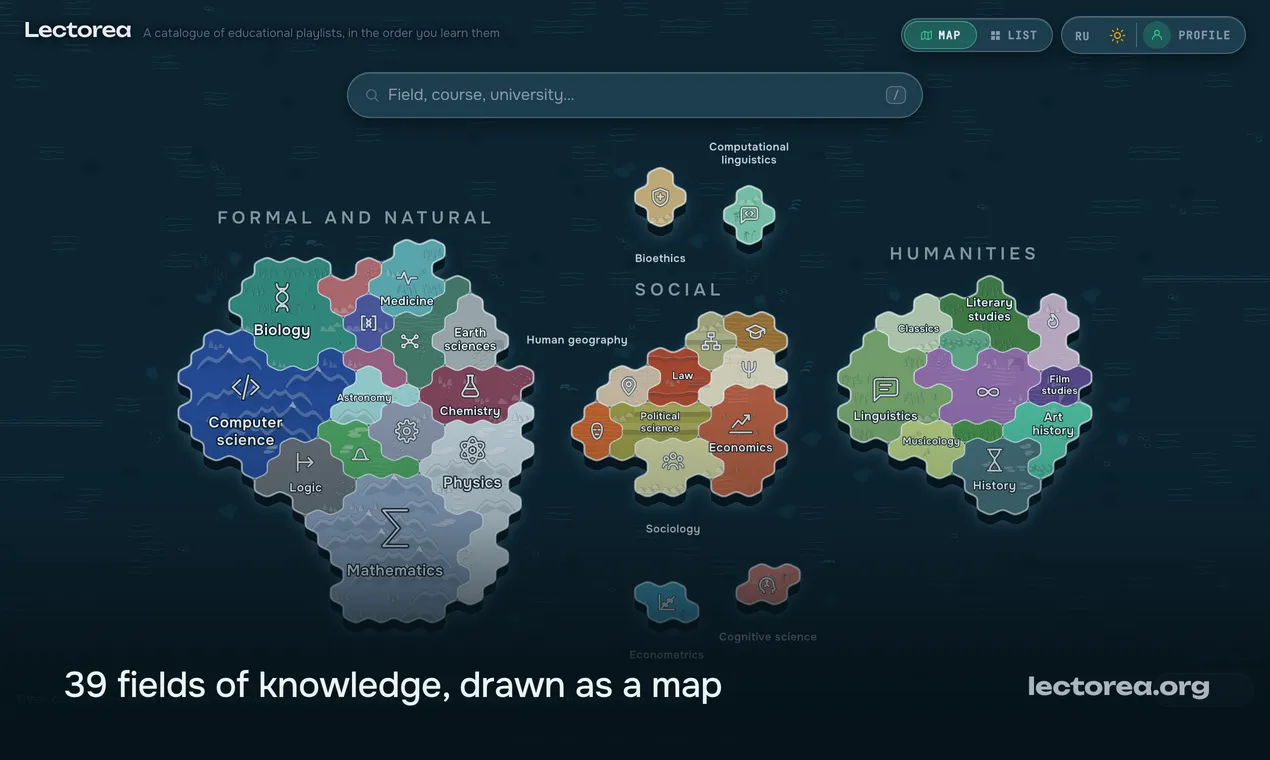
A free catalogue of university lecture courses on YouTube, arranged by what has to come first. Every course knows what it depends on and what it opens up, so a subject becomes a route instead of a pile of links: pick where you want to end up and the site lays out the path, prerequisite by prerequisite, with the recordings for each step. 236 courses across 39 fields, 12,500 lectures from 309 universities and channels, re-crawled every night.
- Role
- Solo — product, data pipeline, front end, deployment
- Period
- Apr 2026 — present
The problem
YouTube can find you a lecture on tensor analysis. It cannot tell you that you will not understand it without linear algebra, and it certainly cannot tell you which four courses stand between where you are and where you want to be.
Every “learn X yourself” list on the internet is someone’s ordering of someone’s bookmarks. Lectorea makes the ordering the data: each course records what it needs before it, and everything else — the path to a goal, what becomes reachable when you finish something, which columns you may have skipped — falls out of that graph.
How it is put together
The catalogue is mined, not typed. A pipeline discovers channels and
playlists, matches recordings to courses, checks them for liveness, pulls
metadata and images, and rebuilds the dataset every night through GitHub
Actions. npm run data:* is about twenty scripts, one per stage, so a bad
crawl can be replayed from the stage it broke at.
The map is generated. Fields of knowledge become territories sized by how much they hold, with real coastlines and labels that appear as you zoom — built offline into tiles, then served as static files.
The state is the viewer’s. Progress lives in the browser by default; the optional Firebase sign-in exists only to carry it to a phone. There is no account to create, nothing to pay for and no tracking beyond the analytics the docs list.
It is a static site. React, Zustand, a build step, and a CDN — a catalogue of this size does not need a server, and not needing one is why it can stay free.
What is hard about it
The matching. A course is an abstraction (“Linear Algebra”); a recording is one lecturer’s take on it, at one university, in one year, sometimes split across two playlists and sometimes missing the last four lectures. Deciding that two playlists are the same course, and that a third only looks like it, is the part that decides whether the catalogue is useful or noise — and it is the part the pipeline spends the most effort on.
Inside the product
Click any frame to enlarge · ← → to move